
Leadership
Organizational Struggles
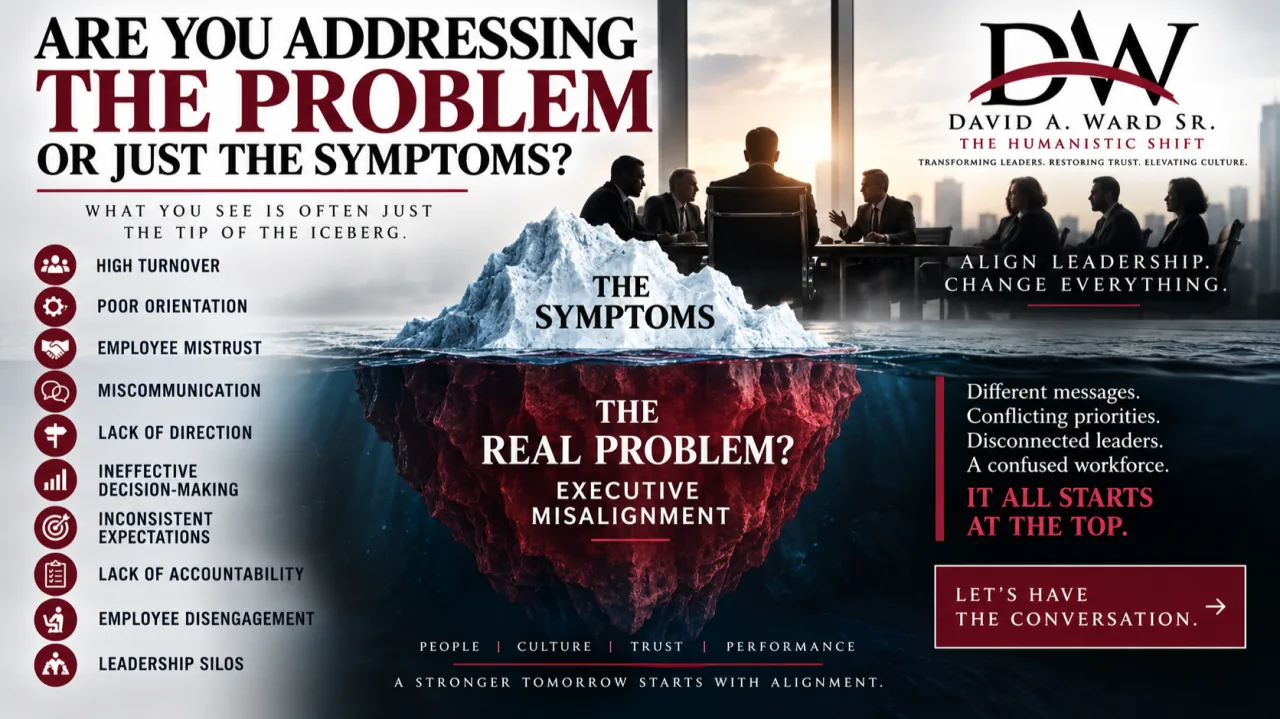
Are You Addressing the Problem or Just the Symptoms?
I want an opportunity to understand your business and what is really causing issues in your organization today.
Not simply what the numbers are telling you. Not just what appears on an employee survey, turnover report, safety report, or exit interview.
I want to understand what is happening beneath the surface.
Are you struggling with:
- New Employee Orientation
- Employee Turnover
- Employee Mistrust
- Ineffective Decision-Making
- Miscommunication
- Lack of Direction
- Inconsistent Expectations
- Lack of Accountability
- Employee Disengagement
- Leadership Silos
If so, I challenge you to consider a critical question:
Are these separate organizational problems, or are they symptoms of something much deeper? This will be one of the most difficult interperspectives your leadership team will face.
Before You Look Down the Organization, Look Across the Executive Table
Organizations often try to solve these challenges individually. Turnover is considered an HR problem. Communication is construed as a management problem. Engagement is viewed as an employee problem. Safety, although an organizational issue, is projected as a safety department issue. Production becomes an operations problem.
But what if many of these issues begin much higher in the organization? Can you look in the mirror? Can you be completely honest with every other executive?
What if the real problem exists in executive misalignment?
When executives are misaligned on the organization's values, expectations, priorities, communication, accountability, and direction, that misalignment doesn't stay in the executive meeting room.
It moves rapidly through the entire organization at every level. Supervisors are confused; employees hear different messages, which creates mistrust and uneasiness.
One executive communicates one priority while another communicates something different. One department holds people accountable while another looks the other way. One leader says employees are the organization's greatest asset while everyday decisions send an entirely different message.
Everyone notices. And eventually, uncertainty becomes frustration. Frustration becomes mistrust. Mistrust becomes disengagement. Disengagement affects performance. And ultimately, people begin looking for somewhere else to work.
Then leadership wonders:
“Why are we losing good people?”
The question that needs to be asked is:
“Where are we failing our employees as executives?”
Executive Alignment Is More Than Agreement
Executive Alignment does not mean everyone thinks alike. Strong leadership teams should have different perspectives, experiences, personalities, and opinions. Alignment means having the courage to work through those differences and emerge with one clear organizational direction.
Your employees should not have to determine which executive's message to follow. They should know: who we are, what we value, and what is expected, and we will hold one another accountable.
Then, once alignment is in place and everyone is engaged, we can then look to the future and where we are going. And how we are going to get there together.
That clarity begins at the executive level.
This Is Where The Humanistic Shift Begins
My work with The Humanistic Shift is not about walking into an organization and pretending I already know the answers. My responsibility is to become a vital part of the organization and its success. It begins with me listening and gathering information to get an accurate picture. I want to understand your organization, your people, your challenges, your culture, and the assumptions that may be preventing your leadership team from seeing what is actually happening. Once I have this information, we can have the toughest conversation your executive team will ever have.
Your executive team must come prepared and willing to do the following:
- Come open-minded
- Leave your ego, title, and assumptions at the door
- It's time for brutal honesty
What we'll do in this meeting will change the mindset, authority, and focus on your core values, definitions, people, leadership, trust, communication, accountability, and the organization's future. Because sustainable organizational change must first be demonstrated at the top.
Executive Alignment creates the foundation for clearer communication, stronger accountability, better decision-making, increased trust, and a unified organizational direction. When leadership aligns, employees finally have what they desperately need: Consistency and Clarity they can trust.
My Call to Action
If your organization is experiencing turnover, mistrust, miscommunication, ineffective decision-making, inconsistent expectations, lack of accountability, or lack of direction, don't immediately assume you have an employee problem.
You may have an alignment problem rooted in leadership.
I would welcome the opportunity to sit down with your executive team, understand what is happening inside your organization, identify where leadership gaps may exist, and begin the conversation necessary to move forward.
You cannot ask your employees to become aligned with an organization whose leaders are not aligned with one another.
The Humanistic Shift begins with leadership.
Align the leaders. Restore trust. Create clarity. Change the trajectory of the organization.
David A. Ward Sr.
The Humanistic Shift:
Transforming Leaders, Restoring Trust, Elevating Culture
Start With a 30-Minute Conversation
If this is the gap in your organization, let's talk for 30 minutes.