
Safety / Families
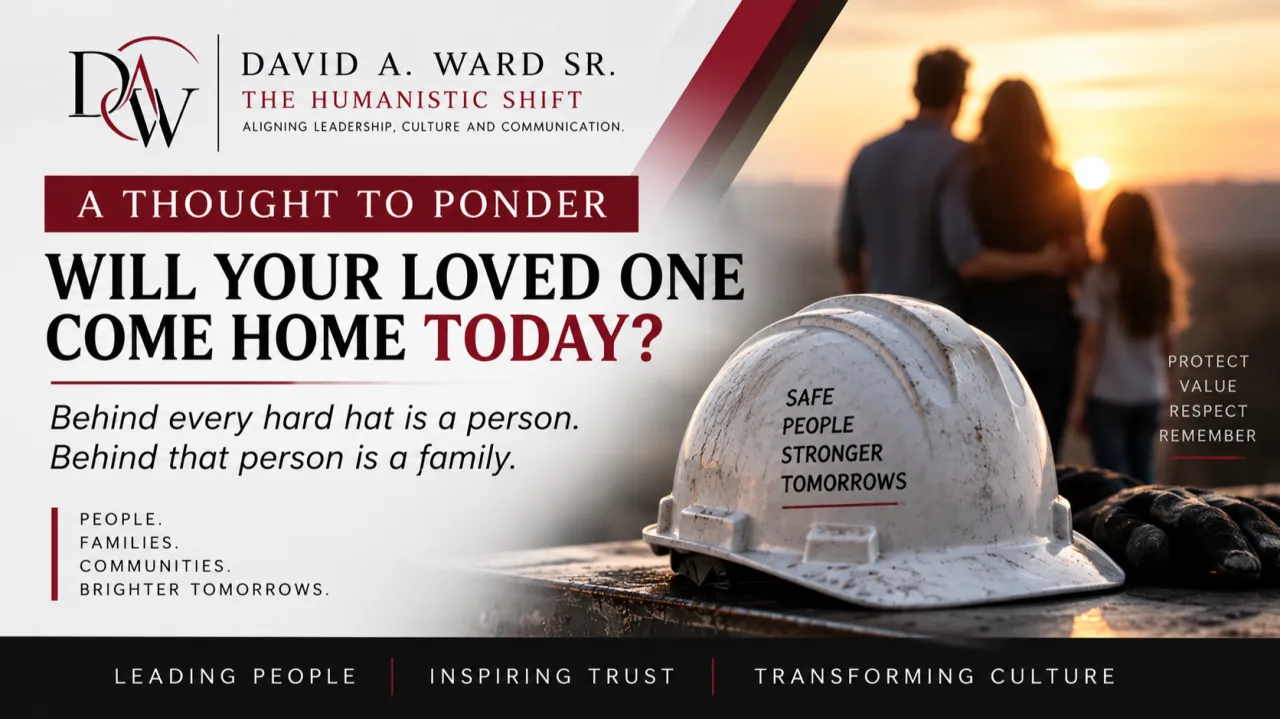
A Thought To Ponder
The value of an employee's life is priceless, to those that matter.
Will Your Loved One Come Home Today?
It is a question none of us want to think about or even ask.
Will it be your husband, wife, significant other, brother, sister, son, daughter, mother, or father who is severely injured or killed at work today?
Think about that question for a moment.
Every morning, millions of people leave home and go to work with an expectation so basic that we rarely even say it out loud: I will come home tonight. Or will my family be forever altered?
Their families have that same expectation. But for some families, the person who walks out the door this morning will not walk back through it tonight. For others, the person who returns home may never be the same. Their lives changed forever. Why?
What Are We Willing to Accept?
We have to be willing to ask a difficult question:
Why do we sometimes allow employees to work under conditions that we would never accept for our own husband, wife, son, daughter, mother, or father?
If you would not allow your loved one to perform a task without the proper training, equipment, safeguards, staffing, or supervision, why should someone else's loved one be expected to? Safety changes when we stop seeing an "employee" and start seeing the human being behind the job title.
Behind every hard hat, uniform, badge, workstation, forklift, machine, hospital bed, construction site, and production line is a person. And behind that person is a family with a future waiting for them to come home.
Who Remembers the Faces Left Behind?
I encourage every executive, supervisor, human resources professional, safety professional, and employee to visit OSHA's Workers Memorial page:
https://www.osha.gov/workers-memorial
OSHA states:
"We value all our fallen workers and offer their families our support, compassion, and appreciation."
Those words should cause every organization to ask a much deeper question:
How do we value, respect, and invest in our employees' safety while they are still here?
How do we remember the employee who was severely injured, permanently disabled, or killed? A deeper question is: do we remember, or do we even care? Do we know anything about their family, kids, and their mental, physical, and financial concerns? Or do we cut a check and call it the price of doing business?
How do we support the spouse whose life suddenly changed? What about the children who lost a parent? The parents who buried a son or daughter? The coworkers who witnessed the incident and carry that memory home?
The supervisor who has to live with the question: Could I have done more?
These are The Faces of Safety and Those Left Behind When Tragedy Strikes.
Some faces appear in reports and investigations. While others never do.
Safety Must Be About More Than Statistics
We talk about incident rates, workers' compensation costs, lost-time cases, insurance premiums, production interruptions, OSHA citations, financial impact of workplace injuries, and the bottom line. Those numbers matter.
But one number matters more: ONE.
- One life.
- One spouse.
- One parent.
- One child.
- One family.
One preventable tragedy is one too many. A serious workplace injury cannot always be reduced to a statistic on a spreadsheet. When someone is permanently injured or killed, the consequences travel far beyond the walls of the organization. They remain with a family for generations.
That is why I believe workplace safety carries a moral obligation to protect and invest in employees' lives and their families.
My Challenge to Leadership
I challenge every CEO, executive, safety professional, human resources leader, manager, and supervisor to stand up and speak for those who cannot.
- Do not walk past the hazard.
- Do not remain silent because addressing it might slow production.
- Do not accept, "That's the way we've always done it."
- Do not assume someone else will handle it.
- Fix and eliminate the hazard today, not tomorrow.
Never let a production number, deadline, budget, or title make you forget the value of a human life.
- Have the courage to stop the work.
- Have the courage to ask the difficult question.
- Have the courage to hold people accountable.
- Have the courage to do the right thing, no matter the cost.
Have the courage to protect someone else's loved one as though they were your own. Because tonight, somewhere, a family will be waiting for the sound of a key in the door. For footsteps in the hallway. For the words, "I'm home."
Every employee deserves the opportunity to say those words at the end of their workday. And every leader has a civic and moral responsibility to do everything reasonably possible to help make sure they can.
Life is short, and we owe it to every employee and every family to invest in their safety and future.
A Final Thought to Ponder
Before your next safety meeting, production meeting, executive meeting, or shift change, look around the room and ask yourself:
If every employee here were a member of my family, would I accept how we invest in their safety, and eliminate the hazardous conditions under which I am asking my employees to work?
If the answer is no, then you already know what needs to change.
Stand up. Speak up. Begin The Humanistic Shift.
Because one life lost is one too many. As a leader, do you have the courage and mental fortitude to do something extraordinary?
David A. Ward Sr.
Founder of The Humanistic Shift
The Humanistic Side of Safety
Start With a 30-Minute Conversation
If this is the gap in your organization, let's talk for 30 minutes.