
Leadership / Accountability
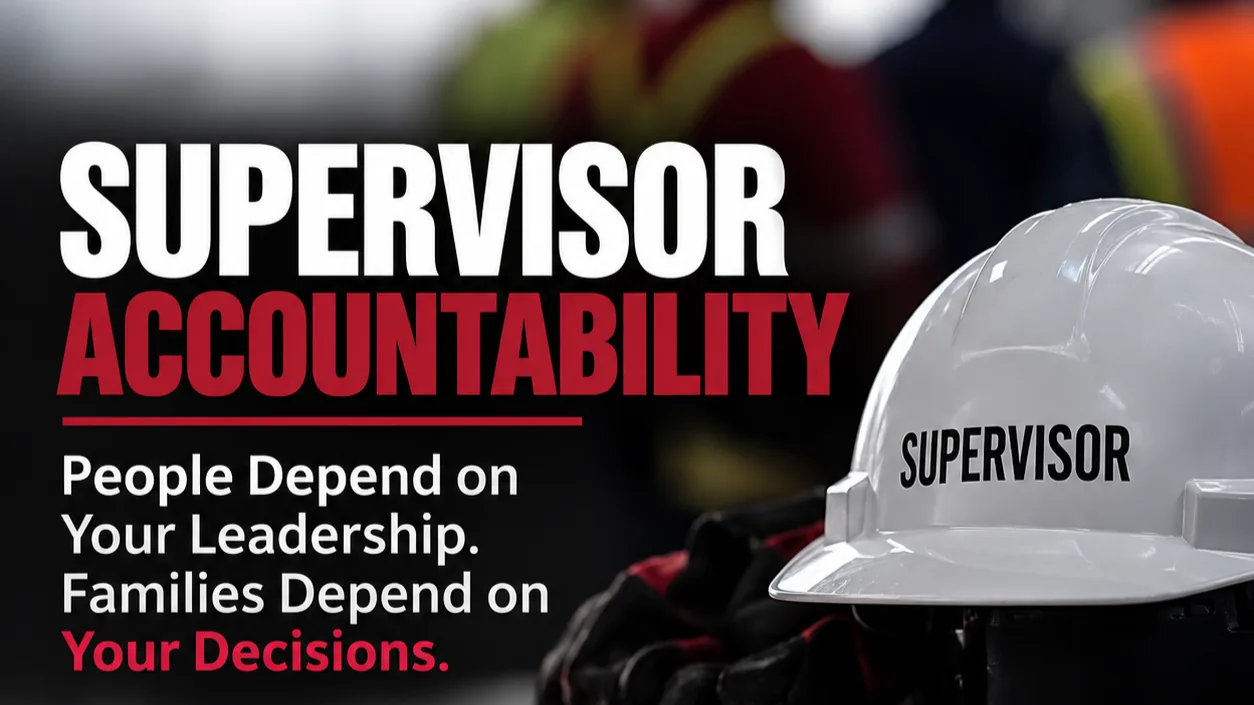
Supervisor Accountability
How many supervisors truly understand how valuable they are to the success of an organization and to the families of the people whose lives have been entrusted to their leadership?
In my workshops and presentations, I talk about the enormous responsibility supervisors accept every day. I also tell supervisors something they may not hear very often:
You are probably not compensated enough for the level of responsibility you carry.
Think about it.
Every employee who reports to you is more than an employee. They may be a husband, wife, mother, father, son, daughter, brother, sister, or someone else's best friend. When that employee arrives for work, two, three, four, or five people at home depend on that supervisor to protect their loved one at all costs.
This changes the meaning of supervision.
The Responsibility Behind the Title
Supervisors are often measured by production, quality, schedules, staffing, attendance, efficiency, and whether the work gets completed. But there is another measurement that must come before all of them:
Were the people entrusted to your leadership protected, valued, and respected at all costs?
Supervisors are the critical connection between executive expectations and what actually happens on the floor, at the jobsite, in the warehouse, throughout the facility, or wherever employees perform their work. Policies do not protect people on their own. Procedures sitting in a binder do not protect people. Safety slogans hanging on a wall do not protect people.
People protect people. And supervisors are positioned every day to make that protection real.
Accountability Is an Act of Leadership
Supervisor accountability should never be reduced to discipline or punishment. Accountability means having the courage to establish expectations, communicate them clearly, model them consistently, and intervene when those expectations are not being met.
It means refusing to walk past an unsafe condition because production is behind. It means refusing to accept, "That's the way we've always done it." It means asking questions before making assumptions. It means listening when an employee raises a concern.
And sometimes it means making an unpopular decision because protecting someone's life matters more than protecting today's production numbers.
Accountability is not a consequence. It is a commitment to protect.
Supervisors, Take a Moment and Let This Sink In
The value you contribute to an organization cannot be measured solely by a monetary figure. If you supervise 20 employees, you are not influencing only 20 lives. Think about the spouses, children, parents, siblings, friends, and communities connected to those employees.
Your decisions can reach far beyond your organization's walls. When you stop an unsafe act, you may never know what you prevented. When you correct a hazard, you may never meet the family whose future you helped protect. When you take an employee's concern seriously, you may never know the incident that did not happen because you listened.
That is the unseen value of great supervision.
But Organizations Must Hold Up Their End
We cannot demand supervisor accountability without giving supervisors the tools, authority, training, expectations, and executive support necessary to succeed. Organizations cannot tell supervisors that safety comes first and then reward them only when production comes first.
We cannot hold supervisors accountable for expectations that executives themselves are unwilling to model. If supervisors are expected to protect people, senior leadership must create an environment where they can stop work, challenge unsafe decisions, raise concerns, and hold people accountable without fearing that doing the right thing will cost them professionally.
Accountability must travel in both directions. Executives must be accountable to supervisors. Supervisors must be accountable to employees. Employees must also be accountable to one another.
That is how culture changes.
The Humanistic Side of Supervisor Accountability
This is where The Humanistic Shift changes the conversation.
Safety cannot be only about compliance, statistics, injury rates, and regulatory requirements. Those things matter, but behind every number is a person. And behind that person is a family member depending on them physically, emotionally, spiritually, financially, for a lifetime.
I want to challenge every organization to ask one simple question:
Have we truly prepared our supervisors to understand the human responsibility that comes with their leadership?
Then I want to challenge every supervisor to ask one simple question:
Do the employees I supervise know through my actions, words, and responsibility that protecting their lives matters to me?
Because at the end of the shift, the greatest measure of leadership is not simply what your team produced. It is whether the people entrusted to your leadership return to those who depend on them every day.
Supervisor accountability is more than a business responsibility. It is a human responsibility and a moral obligation.
If your organization is ready to strengthen supervisor accountability and change the way leaders understand their responsibility for the people they lead, let's start that conversation.
David A. Ward Sr.
The Humanistic Shift
Leading People. Inspiring Change. Transforming Culture.
Start With a 30-Minute Conversation
If this is the gap in your organization, let's talk for 30 minutes.