
Leadership
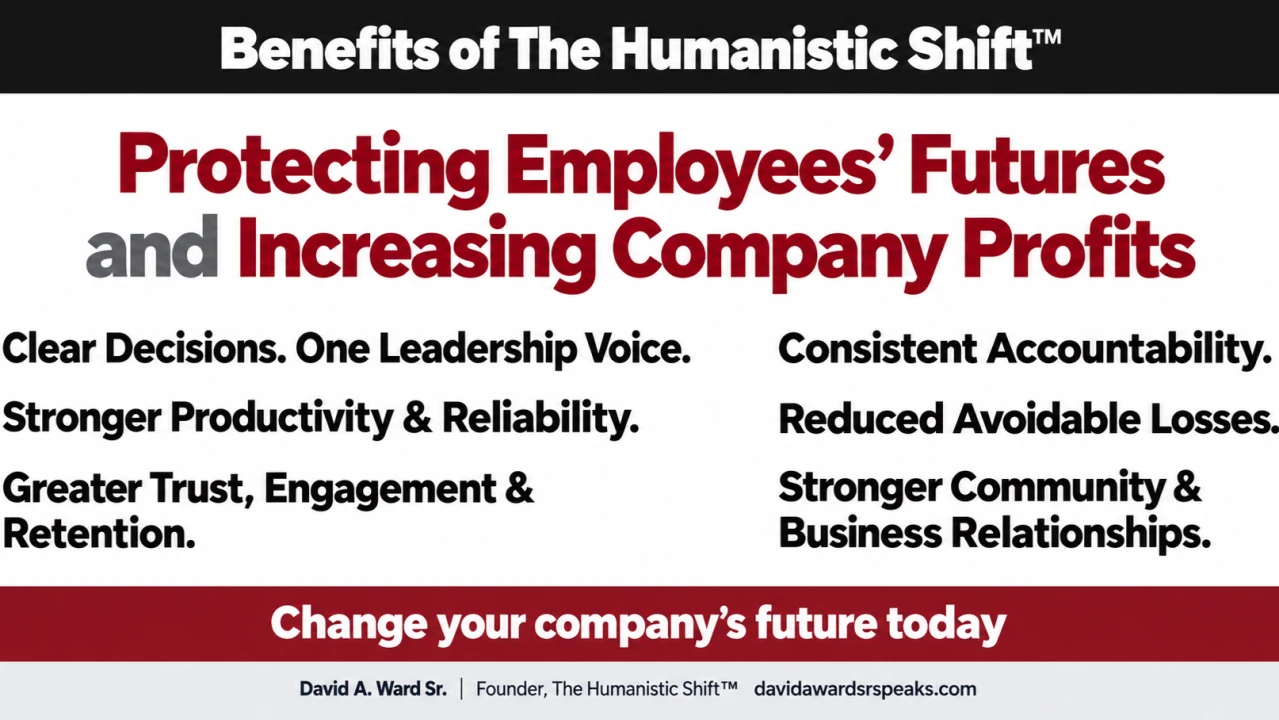
Benefits of The Humanistic Shift™:
Employees valued. Families’ futures protected. Stronger leadership. Positive Community Relationships.
- Reduced financial losses from injuries, turnover, downtime, and rework.
- Precise decision-making with one leadership voice
- Increased production and reliability through coordinated staffing, maintenance, quality, and safety.
- Greater employee engagement, morale, and retention by valuing employees and supporting their growth.
- Enhanced collaboration and relationships across departments, communities, and business partners.
- Protected futures of employees and their families by putting human life at the center of business decisions.
Misalignment creates conflicting decisions, lost talent, disrupted operations, damaged trust, and preventable harm. The Humanistic Shift™ helps executive teams address the leadership conditions behind those losses.
What Changes When Leaders Align and Employees Are Valued?
Your employees experience your leadership long before they believe your promises.
They experience it when production falls behind. When equipment needs repair. When staffing is short. When someone raises a concern and waits to see whether anyone will act. Those moments reveal what your organization truly values.
The Humanistic Shift™ challenges executive teams to own what their decisions create and what their people experience.
Its purpose is clear: Transforming Leaders. Restoring Trust. Elevating Culture.
But what does that mean for your organization?
Listed below are the benefits of the Humanistic Shift that will impact your organization?
Aligned leaders give people clear direction
Ownership begins at the executive table.
When executives use different definitions of safety, quality, accountability, and success, those differences spread throughout the organization. Supervisors receive conflicting instructions. Employees face inconsistent expectations. Departments compete over priorities that leadership has never resolved.
The Humanistic Shift™ brings those differences into the conversation so leaders can establish shared core values, clear expectations, accountability, messages, means of rebuilding trust, and precise communication at all levels.
The benefit is direction people can understand and leadership they can rely on, especially under pressure.
Accountability becomes a commitment people can see
Employees notice when a standard applies to one person but disappears for another. They notice when leaders demand accountability while avoiding their own. The Humanistic Shift™ starts with executives examining their commitments, decisions, and follow-through.
Are expectations clear? Do supervisors have the authority and resources to meet them? Who owns the response when a concern is raised?
Trust grows through follow-through
You cannot ask employees to trust leadership while leaving their concerns unanswered. Trust grows when leaders listen without becoming defensive, explain their decisions, keep commitments, and address conditions that make work harder or less safe.
The Humanistic Shift™ challenges leaders to close the gap between what they intend and what employees experience.
Valuing people strengthens the business
Every employee brings knowledge, judgment, relationships, and experience into your organization. Each person also has a life beyond work and people depending on their future. Investing in their training, development, safety, and success helps create conditions where people can contribute and feel valued as human beings and as important members with a vested interest in the organization and its success. That investment supports stronger continuity across the business.
Protecting people and building a sustainable, profitable organization belong in the same leadership conversation.
Culture becomes visible in everyday decisions
Written core values gain meaning when they guide staffing, maintenance, purchasing, training, and production. Employees should not have to guess whether protecting human life is a core value. Culture changes when leaders treat core values as more than statistics; profits don't negate safety, and every employee's value is non-negotiable.
The benefit is a culture people can see, feel, and experience with values that hold under pressure.
Your next step begins at the executive table
Before asking employees to change, examine what your leadership team has created. What have you assumed is working? What are your people experiencing that you have not heard? What are you willing to own and change?
W I N: Why. Invest. Now.
W-Why: Every life has a value; every employee has a loved one who depends on them, and it’s leadership's responsibility to ensure a safe work environment at all costs.
I-Invest: We needed to show our investment at every level by trusting leadership and providing the oversight, direction, and guidance needed.
N-Now: It was all about being proactive, not waiting for a tragedy to happen and then reacting.
Your people are experiencing your leadership today. Give them evidence that they matter.
David A. Ward Sr., Founder of The Humanistic Shift™
Start With a 30-Minute Conversation
If this is the gap in your organization, let's talk for 30 minutes.