
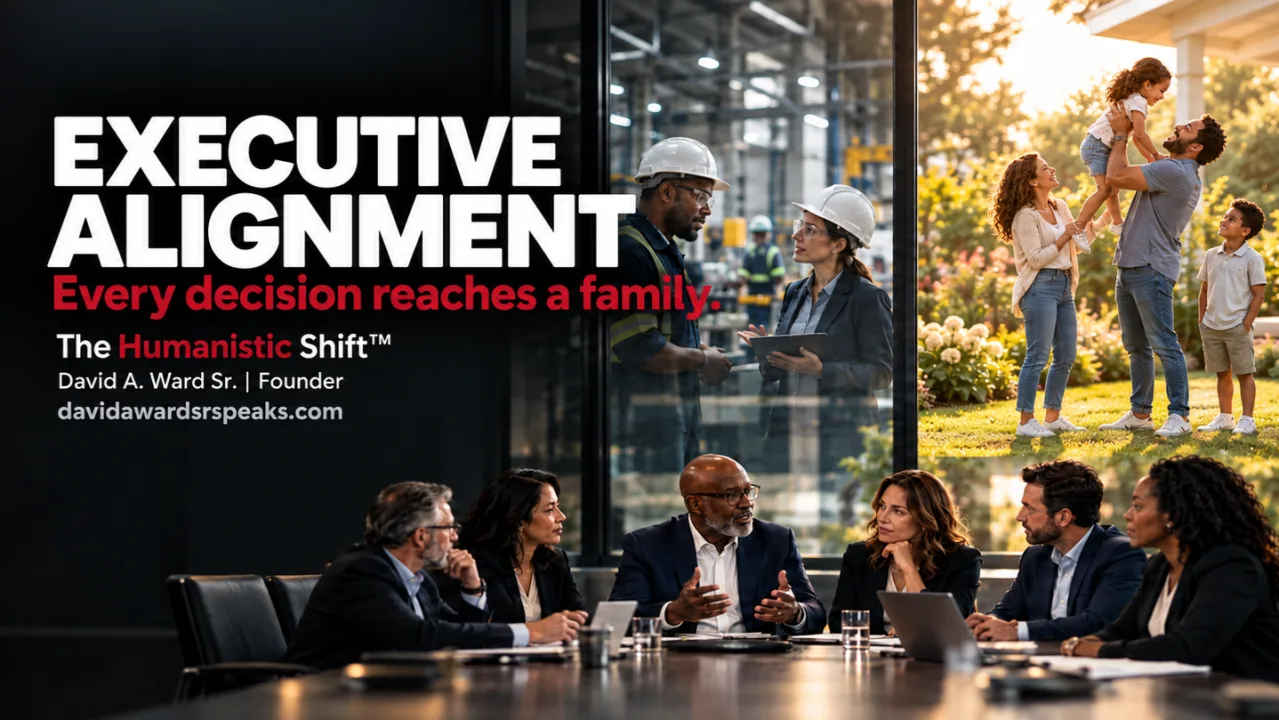
Leadership / Humanistic Shift
What Is The Humanistic Shift™ and What Value Does It Bring to Your Organization?
My answer begins with a question:
Do your employees experience the same values your leadership team believes it demonstrates?
Your executives may agree that safety matters, employees deserve respect, and trust is essential. But what happens when production falls behind, staffing is short, equipment fails, or protecting someone requires an investment?
Those moments reveal what your organization's core values are and whether your leaders are aligned.
What is The Humanistic Shift?
The Humanistic Shift™ helps executive teams examine and align the commitments that shape everyday work:
- Core values: What will we protect, even under pressure?
- Definitions: Do we mean the same thing when we say safety, respect, accountability, and trust?
- Expectations: Does everyone understand what is required—and receive the support to succeed?
- Accountability: Will we hold ourselves to the expectations we set for others?
- Communication: Do our decisions and messages provide clear, consistent direction?
- One voice: Can employees rely on the same commitments across departments and leadership levels?
This work requires the most uncomfortable and honest conversations executive teams will encounter. Leaders must be willing to be vulnerable, respectful, and to hear constructive criticism when their intentions differ from what employees and supervisors experience.
This is where looking across the executive table becomes critical to your success.
Why does alignment matter?
When leaders are not aligned, the entire organization pays the price. Conflicting priorities weaken security, compromise safety, undermine quality, disrupt production, and erode profitability. Mixed messages leave employees guessing, supervisors struggling, and trust deteriorating. The consequences reach beyond your walls, damaging customer confidence, business partnerships, and community relationships.
Consider a supervisor who hears, “Never compromise safety,” but also hears, “Meet the deadline, no exceptions.”
Without clear core values, adequate resources, and executive support, that supervisor faces conflicting expectations. Employees notice the conflict. Over time, the message falls on deaf ears, and the trust begins to erode.
When leaders align, the benefits reach every person their decisions touch.
For executives, alignment establishes shared priorities and a clear basis for decisions. It strengthens their ability to resolve competing demands, invest resources wisely, and speak with one voice.
For supervisors, alignment provides clear expectations, consistent direction, and leadership support. They gain the authority and resources to protect employees while meeting operational responsibilities.
For employees, alignment makes organizational values visible through fair treatment, reliable communication, and follow-through. People have greater reason to trust leadership, raise concerns, contribute ideas, and take ownership of their work.
For the business, alignment strengthens coordination across security, safety, quality, and production. It reduces confusion, conflicting instructions, and avoidable rework—supporting productivity, profitability, and long-term stability.
For business partners and the community, alignment builds confidence in an organization that honors commitments, communicates clearly, and takes responsibility for its impact on people and families.
Accountability gives alignment its credibility. When expectations apply to everyone, regardless of position or title, leaders demonstrate that their commitments can be trusted. That consistency earns respect, strengthens relationships, and gives the entire organization a shared direction.
What value does it bring to your organization?
The value becomes visible in how people work together.
Clearer decisions. Shared values and definitions help leaders address competing priorities with less confusion.
Stronger coordination. Consistent expectations help departments understand their responsibilities and how their decisions affect others.
Greater credibility and trust. Employees have more reason to trust leaders who listen, explain decisions, provide support, and follow through.
Better conditions for performance. Clear direction and adequate resources help people do their work safely and effectively, reducing avoidable conflict, delays, and rework.
Protection for people and their futures. Decisions about staffing, maintenance, training, and equipment affect human lives—and the families depending on them.
Alignment is a commitment every leader must honor in every decision, every day with no exceptions. It must guide how you protect employees, allocate resources, communicate expectations, and hold one another accountable, especially under pressure. No title, production target, or profit margin excuses abandoning that commitment.
Your people are trusting you with more than their work. They are trusting you with their lives, their futures, and the families counting on them. Every decision you make either honors that trust or gives them a reason to question it. That decision is yours.
We created this culture. We own its consequences. Now we must have the courage to uphold our commitments and hold ourselves and one another accountable. Every leader. Every decision. Every day. No exceptions.
Our actions must give our people a reason to trust us today, and their tomorrows.
What value does it bring to you as a leader?
As a leader, you have a non-negotiable responsibility to make expectations clear, demonstrate them through your actions, and support the people you depend on. You must earn their confidence to raise concerns and respond with respect, protection, and follow-through. If your previous actions have taught people to remain silent, you must take ownership and change what they experience.
You and your fellow leaders must hold one another accountable for these commitments. No title exempts you. No pressure excuses you. Your people’s safety, trust, and futures depend on what you consistently do.
You accept responsibility for stating your commitments clearly, providing the staffing, training, equipment, and authority to fulfill them, and enforcing the same expectations for everyone—including yourself. You respond when concerns are raised, follow through on promised actions, and uphold those commitments when deadlines, production, or profits are under pressure. No exceptions.
Why I created The Humanistic Shift
I have sat with the aftermath, not just the paperwork.
Throughout my career in safety, federal investigations, insurance consulting, and leadership, I have seen what happens when decisions fail to protect people and executives are misaligned.
I have also seen people trying to do the right thing while navigating conflicting instructions, unsupported expectations, and leadership commitments that weakened under pressure. When executives leave those conflicts unresolved, employees are left to carry the risk. Their families can inherit the consequences.
An investigation may close. A company may resume production. But a family can spend the rest of their lives living with what happened. Someone’s chair stays empty. Someone becomes a caregiver overnight. A child’s future changes because a parent never comes home.
I created The Humanistic Shift™ to bring the lives affected by leadership decisions into the room where those decisions are made. Every person discussed as a headcount, a labor cost, or a production requirement is someone whose absence would change a family forever. Their humanity must have a voice at the executive table.
That is where leaders must establish core values they will uphold under pressure, commit the resources to live them, and accept accountability for what their decisions ask others to risk. If protecting people loses its authority when production falls behind, or profits are threatened, leadership has made its values conditional and placed the consequences in someone else’s hands.
Before you ask employees to trust your leadership, answer this:
If the families of your employees could see every decision you made today, what would prove to them that you valued the person they are waiting to welcome home? The answer must show up in staffing, training, equipment, production demands, and how you respond when someone raises a concern. It must hold when protecting people costs money, delays work, or requires a leader to admit they were wrong and take full responsibility.
My conviction is unwavering: aligning leadership and investing in your people's safety are moral obligations, leadership responsibilities, and essential foundations for a productive, secure, safe, profitable, sustainable business.
Executive alignment determines whether those commitments survive the pressures of doing business. Leaders must agree on the core values they will uphold, provide the resources to honor them, and hold one another accountable. When executives give conflicting direction, uncertainty reaches supervisors and employees, and the consequences extend far beyond the organization, affecting every family member.
Every person who works for you is building a life beyond your walls. Their paycheck supports a household. Their presence steadies a family. Their knowledge strengthens your business. Their relationships connect your organization to the community. Protecting that person protects a future that belongs to more people than leadership may ever meet.
Investing in their safety helps preserve the experience your business depends on, strengthens employees’ confidence in leadership, and demonstrates to customers, partners, and neighbors that your commitments hold when they carry a cost. The future of your business is bound to the futures of the people who sustain it.
I created The Humanistic Shift™ because no family should have to suffer a tragedy before leadership understands the value of the person they lost. That understanding must begin at the executive table and become visible in every investment, every expectation, and every decision. No exceptions.
Where does your organization begin?
Before you ask your employees to trust your leadership, look across the executive table. Are you giving them the same reasons to trust each of you?
Bring your executives together. Establish shared core values, definitions, expectations, and accountability with no exemptions for position or title. Then ask employees and supervisors whether your daily decisions uphold those commitments. Listen without defending. Take ownership of the gaps. Commit resources, name who is responsible, and follow through.
Your intentions don’t protect people. Your decisions do. Make them count, as lives depend on it.
Every day you postpone this conversation, your people continue working within the conditions your leadership has created. The question remains: is that acceptable to you?
Schedule an executive alignment conversation with David A. Ward Sr., Founder of The Humanistic Shift™. Bring your team and the willingness to act on what you uncover.
davidawardsrspeaks.com
Visit davidawardsrspeaks.com to schedule a conversation.
David A. Ward, Sr. Founder of The Humanistic Shift™ Transforming Leaders, Restoring Trust, Elevating Culture
Start With a 30-Minute Conversation
If this is the gap in your organization, let's talk for 30 minutes.
Veteran-Owned and Operated