
Leadership / Humanistic Shift
Why the Leadership Gap Exists
And Why The Humanistic Shift Is No Longer Optional
The leadership gap did not appear overnight. It has been developing quietly as the workforce changed faster than many organizations changed the way they lead.
Today’s employees are entering workplaces with different expectations about leadership, communication, respect, opportunity, accountability, and purpose. Yet many organizations are still attempting to lead a changing workforce with leadership practices designed for another generation.
That disconnect is the gap.
The Humanistic Shift challenges executives to recognize that closing this gap requires more than another leadership program. It requires a fundamental shift in how organizations lead people, build relationships, rebuild employee trust and engagement, communicate expectations, and create accountability.
What Is Driving the Gap?
- Generational Transition
- Outdated Leadership Models
- Failure to Identify and Develop Future Leaders
- A Coaching Deficit
- Barriers to Opportunity
The Humanistic Shift
Closing the leadership gap begins when executives stop asking:
“What is wrong with our employees?”
and begin asking:
“What must change in the way we lead them?”
The Humanistic Shift places people back at the forefront of leadership. It calls for executive alignment, clear communication, leadership accountability, employee trust, meaningful development, and a culture where people understand both what is expected of them and why their contribution matters.
This is not about lowering standards. It's about a moral obligation to protect and invest in our employees at all costs.
It is about raising the standard of leadership from words into action.
When leadership fails to evolve, the consequences eventually show up in turnover, disengagement, mistrust, poor communication, inconsistent accountability, declining morale, safety concerns, and lost organizational knowledge.
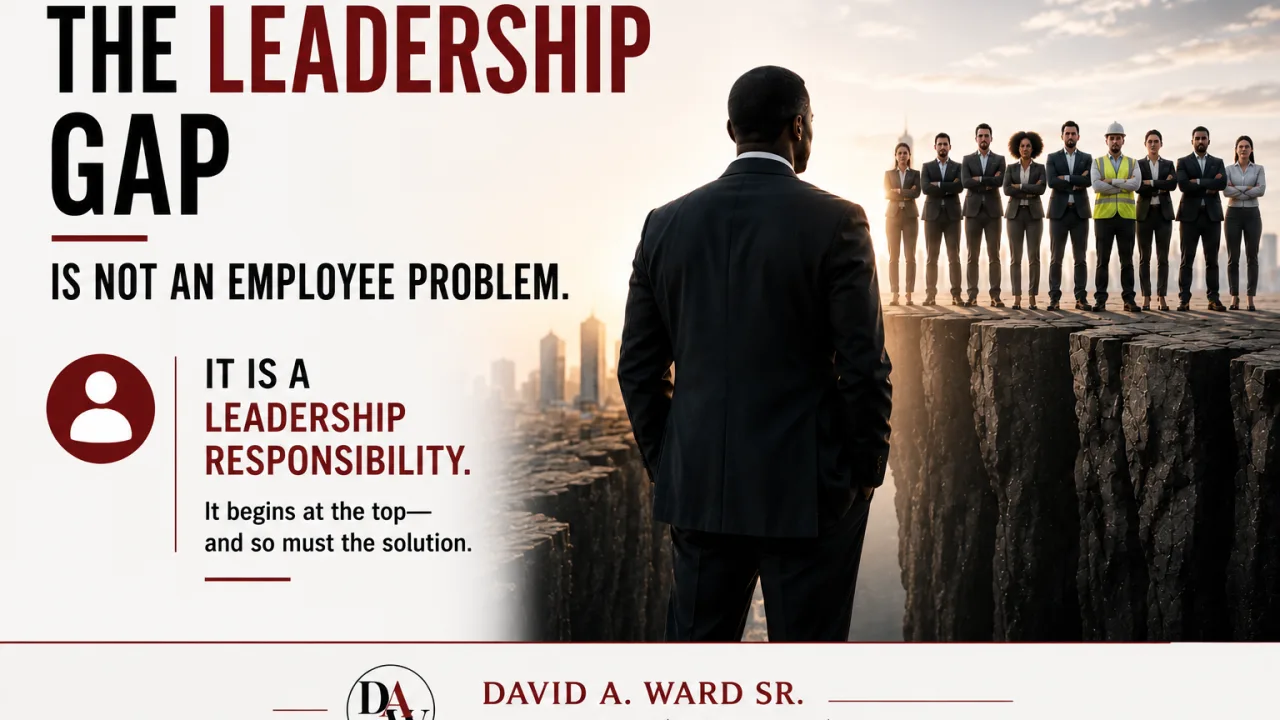
The leadership gap is not an employee problem.
It is a leadership problem, and the employees pay the consequences.
- The employee who no longer feels valued pays.
- By the supervisor who was promoted but never prepared to lead.
- By the talented employee who walks away because trust has been broken.
- By the team that has stopped speaking because they no longer believe leadership is listening.
- And ultimately, by the organization that cannot understand why its culture, engagement, retention, safety, and performance keep declining.
The gap begins at the top and so must the solution.
Executives cannot ask employees to become more engaged while leadership remains disconnected. We cannot demand accountability without demonstrating it. We cannot ask for trust while sending mixed messages. And we cannot expect people to give their best to an organization when leadership has failed to show them that they matter.
This is where The Humanistic Shift begins.
It begins with the courage to look inward to set aside titles, positions, egos, personal agendas, and the need to be right, and have the difficult conversations necessary to confront what is broken, rebuild what has been lost, and lead together with one voice, one purpose, and one commitment to the people who depend on your leadership.
To align leadership. To rebuild trust. To listen before assuming. To develop and value our employees instead of simply directing them. And to recognize that behind every position, every productivity number, every safety statistic, and every business decision is a human being and a family whose future may be affected by the decisions we make.
The leadership gap is not just a performance gap. It is a gap between people and leadership. Between expectations and actions. Between what organizations say they value and what their employees actually experience.
Closing this gap is not optional for organizations that intend to survive, grow, and lead into the future.
The Humanistic Shift challenges every executive team to:
Close the gap one leader, one decision, one conversation, and one employee at a time.
The question every executive team should be willing to confront is:
Are we, as leaders, failing our workforce by our values, actions, communication, respect, and accountability?
The Humanistic Shift begins with that conversation.
David A. Ward Sr.
The Humanistic Shift
Transforming Leaders. Restoring Trust. Elevating Culture.
Start With a 30-Minute Conversation
If this is the gap in your organization, let's talk for 30 minutes.