
Leadership / Executive Alignment
Executive Alignment: A Must For Business Success
As an executive, one question could change the trajectory of your entire organization:
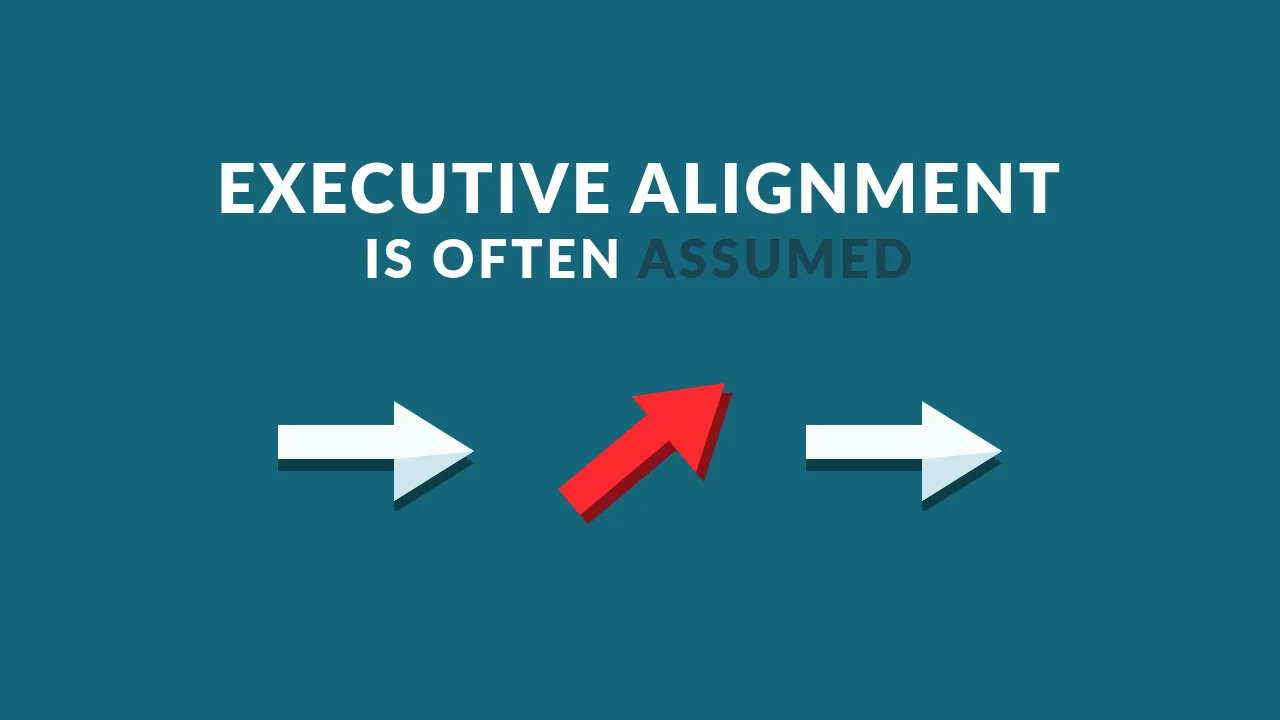
Are we truly aligned as an executive leadership team?
It sounds like a simple question. It isn't.
Put a CEO, COO, CFO, HR executive, Safety leader, Operations leader, Quality leader, and other senior decision-makers around the same table, and you naturally bring together different responsibilities, experiences, priorities, communication styles, and opinions.
That diversity can strengthen an organization. But only when leadership is aligned.
Without alignment, those differences can create competing priorities, inconsistent expectations, mixed messages, organizational silos, and confusion that travels directly to supervisors and the frontline. That's where executives must be willing to have a different kind of conversation.
Before entering the room, leave the title, ego, departmental agenda, and preconceived answers outside the door. Come prepared to listen. Come prepared to challenge assumptions, including your own. Come prepared to hear something you may not agree with. And most importantly, come prepared to ask:
What is best for our people and the future of this organization, not simply my department?
Misalignment Does Not Stay at the Executive Table
When executives are not aligned, employees eventually feel it. Safety says, "Do not take the risk." Operations says, "We have to make the number." Quality says, "It cannot leave the facility like this." Maintenance says, "We need downtime to fix it correctly." HR says, "This is how we expect our people to be treated." Finance says, "We need to control the cost."
Individually, each message may be legitimate. But what happens when no one has established which core values govern when those objectives collide? The supervisor is left to interpret. The employee is left to choose. And eventually, assumptions become the decision making system.
That is not alignment.
Your Employees Are Watching
Executives may believe they are aligned because everyone agreed during the meeting. But boardroom agreement is not the true test. The employee experience is. Walk onto the floor and ask employees what matters most to leadership. Ask supervisors what they are expected to prioritize when safety, production, quality, staffing, and cost come into conflict.
Ask whether employees believe they can stop work when something is wrong. Ask whether standards apply equally when the organization is under pressure. Then compare those answers with what the executive team believes it communicated.
The distance between those two realities is your leadership alignment gap. And that gap has consequences. It affects trust. It affects safety. It affects accountability. It affects employee engagement. It affects retention. It affects productivity and quality.
And ultimately, it affects profitability and the sustainability of the business.
Alignment Does Not Mean Agreement
This is important. Executive alignment does not mean everyone thinks alike. In fact, I would be concerned about a leadership team where nobody challenges anyone. Strong executive teams disagree. They ask difficult questions. They challenge assumptions. They debate core values and priorities. They bring uncomfortable realities into the room. But they do it with enough trust and humility to understand that disagreement is not disrespect.
The objective is not to win the argument. The objective is to strengthen the organization. Once the discussion is complete and the direction is established, leadership must leave the room with clarity:
One direction. One set of expectations. One standard of accountability. One leadership voice.
Employees should never have to determine which executive's core values matter most.
The Conversation Requires Courage
This is where executive alignment becomes difficult. Someone has to be willing to say:
"What we are currently doing is not working."
Someone has to ask:
"Are our decisions consistent with the values we say we have?"
Someone has to challenge:
"Why are employees experiencing something different from what we believe we are providing?"
And sometimes an executive has to be willing to admit:
"Are we part of the problem?"
That takes courage. But that is leadership. Because meaningful transformation rarely begins by identifying what everyone else needs to change. It begins when leaders are willing to examine themselves first.
Alignment Must Come Before Action
Organizations often rush directly to solutions. Another training program. Another policy. Another initiative. Another employee engagement campaign. Another safety message.
But if the executive team hasn't first aligned on their core values, expectations, communications, accountability, what will be reinforced, and what will never be compromised, those initiatives eventually become another failed opportunity.
That is why my approach begins with:
Alignment → Awareness → Action
Alignment - Establish a shared leadership direction and clarify what the organization truly stands for.
Awareness - Expose the gaps between leadership intention and what supervisors and employees are actually experiencing.
Action - Turn that understanding into visible leadership behaviors, consistent accountability, and decisions employees can trust.
Because alignment without action is just conversation. And action without alignment creates confusion.
A Challenge for Your Next Executive Meeting
Before reviewing the financials, production numbers, safety metrics, quality reports, or staffing concerns, put one question on the screen:
Are we truly aligned?
Then go deeper.
- What happens when safety, quality, production, operations, and programs compete?
- What behaviors are we tolerating that contradict our stated values?
- Are our supervisors hearing one consistent message from leadership?
- Do employees experience the culture we believe we have created?
- Do our people trust us enough to tell us when we are wrong?
And perhaps the most difficult question:
What are we unwilling to confront because the conversation might make us uncomfortable?
Those answers may tell you more about the future of your organization than another dashboard ever will.
After more than four decades in this work, I have learned that organizations rarely suffer because they lack another slogan, policy, or program. Too often, the deeper problem begins with assumptions, silence, inconsistent accountability, and leadership teams that were never truly aligned.
Executive alignment is not a meeting exercise. It is a business imperative.
Because what happens at the executive table eventually reaches the supervisor. What reaches the supervisor eventually reaches the frontline. And what reaches the frontline eventually becomes your culture, your performance, and your results.
My Call to Executive Leaders
Have the conversation. Not the comfortable one. The necessary one. Put the titles aside. Put the egos aside. Challenge the assumptions. Listen to one another. Decide what truly matters.
Then walk out of that room prepared to demonstrate those decisions with one voice and through consistent action. Align the leadership. Equip the middle. Engage the frontline. Change the experience.
Because sustainable transformation does not begin on the floor.
It begins at the executive table.
David A. Ward, Sr.
The Humanistic Shift™
Transforming Leaders. Restoring Trust. Elevating Culture.
Start With a 30-Minute Conversation
If this is the gap in your organization, let's talk for 30 minutes.